
Community Corrections Release Status
The Suffolk County Community Corrections Center is a conditional pre-release and supervision operation, not a conventional jail roster. SCSD’s Custody Assessment material says selected House of Correction participants may live at home or in a halfway house while remaining in departmental custody. Field Supervision staff monitor reporting and other conditions. Thus, leaving the South Bay secure building can begin a less restrictive placement without ending the custodial sentence.
A final community release is a later, distinct event. It might reflect expiration of sentence, parole, probation, or another lawful discharge. Ask which event actually occurred and on what date. If the person merely entered the Community Corrections Center, use “conditional pre-release” or “community placement.” Those terms describe the status more accurately than “released inmate.”
| Status | Meaning | Best record |
|---|---|---|
| Home placement | May remain in SCSD custody | Custody Assessment and Field Supervision record |
| Halfway placement | Less restrictive placement, not automatic discharge | SCSD placement and custody entry |
| Final discharge | Underlying SCSD custody ends | Completed discharge entry and court record |
| Return to secure custody | Community placement ends, sentence continues | SCSD transfer or return entry |
Confirm Community Corrections Discharge
No official public named-person web list documents Suffolk community placements or final discharges. Massachusetts VINELink is also the wrong first tool. The Commonwealth says only Massachusetts DOC participates in the state VINE program, while this center is run by SCSD. Confirmation must come from the department and the sentence docket.
- Ask whether the person came from the Suffolk County House of Correction into Custody Assessment or Community Corrections.
- Call the Community Corrections contact and ask whether SCSD custody or Field Supervision remains active.
- Request the date and character of the latest event: placement, return, transfer, parole, probation, or final discharge.
- Match the agency response to the sentencing docket and any supervising-agency record.
- Submit a focused SCSD records request if a written placement or discharge entry is needed.
A person can be physically at home and still be in departmental custody. Conversely, a person may finish SCSD custody and begin parole or probation supervision. The Suffolk County release-record search distinguishes these handoffs and shows when another official agency must be checked.
Community Corrections Record Contact
Direct status questions to the Suffolk County Community Corrections Center. The published contact does not list separate hours, so avoid assuming walk-in or telephone availability beyond what the department confirms. Ask whether the participant remains in SCSD custody and whether a later final-discharge record exists.
Suffolk County Community Corrections Center
33 Bradston Street
Boston, MA 02118
617-635-1000 extension 2500
For documents, the SCSD Records Access Officer is listed at 200 Nashua Street, Boston, MA 02114, by email at psullivan@scsdma.org, and at 617-635-1100 extension 6373. Describe the requested record with the person’s full name, date of birth if known, SCSD identifier if known, placement date range, and exact event fields. Ask for the Community Corrections placement, return, transfer, and final-discharge entries rather than a newly prepared status summary.
Massachusetts public-record law generally calls for production or a compliant written response within ten business days. Redactions or withholding can apply to protected material. A records response does not replace the court docket, which supplies the sentence and judicial orders behind SCSD action.
Community Corrections Custody Model
SCSD describes Custody Assessment as a conditional pre-release program for carefully selected HOC inmates. The Field Supervision Unit oversees participants and required reporting. That model sits between secure confinement and final sentence discharge. It is therefore more precise to describe a participant’s location, supervising unit, and legal custody separately.
The official Community Corrections page documents conditional status and Field Supervision, as captured below.
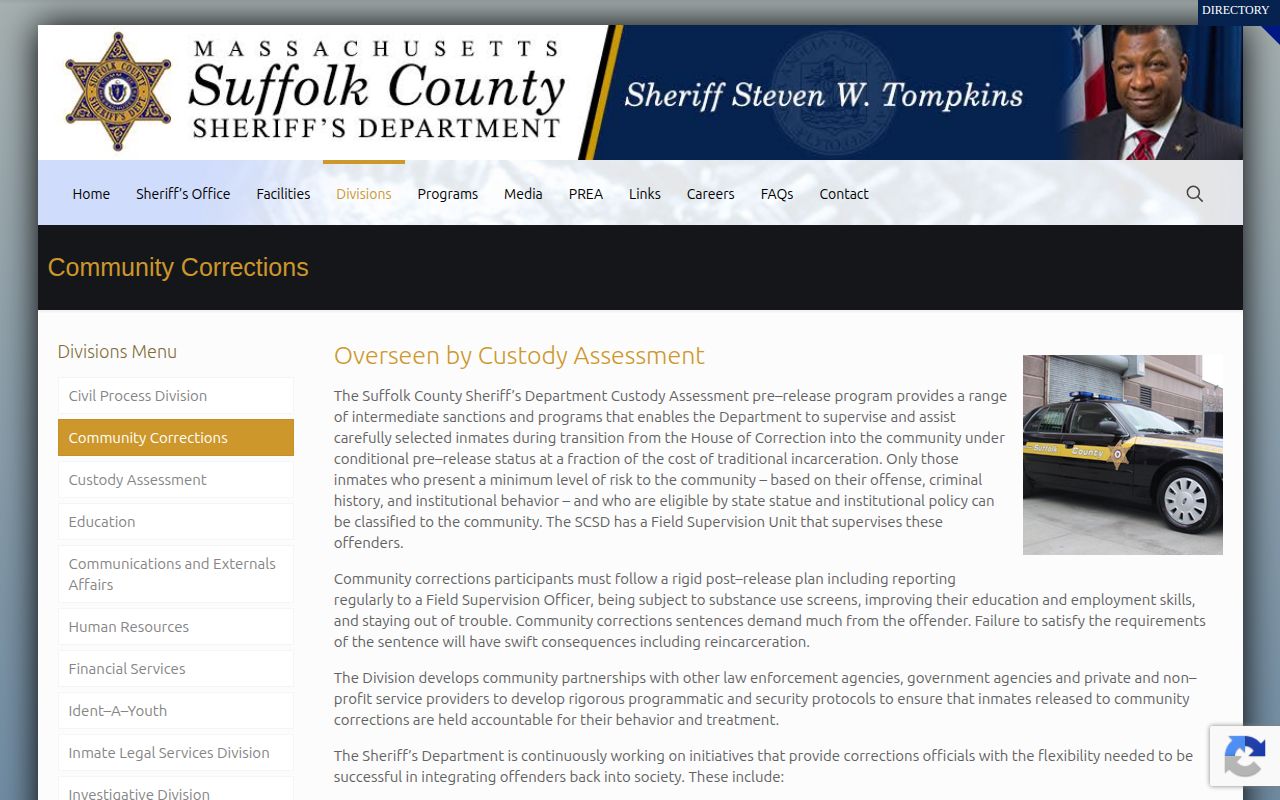
The source supports the key distinction: community movement can occur while the participant remains under departmental custody and monitoring.
A current-custody question should name the exact program. “Not at South Bay” is incomplete because Brooke House, McGrath House, a home placement, a return to HOC, or another transfer can each explain the move. The latest SCSD entry should identify which one applies.
Community Corrections Placement Records
SCSD names Brooke House for men and McGrath House for women among halfway-house services. A halfway-house address indicates the setting, not the end of the sentence. The placement record should show when the person entered, which SCSD unit retained authority, and whether a later return or discharge occurred. Avoid inferring status from mail, social media, or an address alone.
If the person returned to secure custody, request the return or transfer entry. If the person moved from Community Corrections into parole, ask for both SCSD’s custody-ending event and the Parole Board’s supervision record. When probation followed, the relevant sentencing court and Probation Service hold that portion of the trail. Each record answers a different stage.
Note: A halfway house can be a custodial placement, so physical freedom of movement is not the same as legal discharge.
Field Supervision Release Records
Field Supervision is part of SCSD’s conditional structure. Reporting, monitoring, and the possibility of return distinguish it from an ordinary completed sentence. A participant’s compliance or daily schedule is not a public release list. The useful records question is whether departmental custody is active and what formal event last changed that status.
Use a narrow date range. Ask for existing custody-status fields, placement date, assigned operation, return or transfer date, and final discharge when one exists. If the agency withholds protected case detail, request all segregable nonexempt portions and the cited basis for redaction. The resulting entry can then be compared with the court record without exposing unnecessary personal information.
Community Corrections Release Planning
Suffolk reentry programs can assist with identity documents, transportation, residential treatment planning, and follow-up. Those services are relevant to a transition from the HOC, yet they do not prove that the person reached final discharge. A discharge panel may occur before the anticipated end date, and a community placement may continue under SCSD authority.
Keep service planning and records proof separate. For practical support, use the person’s assigned SCSD contacts. For legal status, use Custody Assessment, the final SCSD entry, the sentencing docket, and any parole or probation record. This sequence preserves the local nuance that makes Suffolk Community Corrections different from a simple jail-release route.
Community Corrections Release Timeline
A complete record should show more than the date a person left South Bay. Ask for the HOC admission and sentence identifiers, the date Custody Assessment approved conditional pre-release, the placement type, the Field Supervision status, any return or transfer, and the later final-discharge entry. The sequence can show weeks or months of community placement before SCSD custody actually ended. Without that final entry, describing the person as discharged is premature.
Each possible next status has a different owner. SCSD documents conditional placement and the end of sheriff custody. The Massachusetts Parole Board owns parole supervision. The sentencing court and Probation Service own probation. Massachusetts DOC owns a state-prison transfer. Another sheriff or federal agency owns its accepted transfer. Follow the destination named in the SCSD entry rather than searching every system at once.
Written requests should be narrow. Give the full name, date of birth if known, SCSD number if known, HOC episode, Community Corrections placement, and a focused date range. Ask for existing admission, placement, supervision-status, return, transfer, and final-discharge fields. If the request captures protected case details, SCSD may redact those parts. Request the segregable custody information that can be released.
Massachusetts retention rules list House of Correction records for twenty-five years after release and mittimus files for ten years after release or termination of parole. Retention does not create an online archive or guarantee access to every field. It does show why an old conditional placement can still be worth a formal records request even when no public name search exists.
The court record is the cross-check. It may show the sentence, later order, probation, or disposition but not the exact time SCSD changed the participant’s placement. Conversely, the department record may show a physical or supervision change without fully explaining the judicial basis. Use both when deciding whether the latest event was conditional placement or final release. When the placement record stops without a clear outcome, ask SCSD for the next return, transfer, parole, probation, expiration, or discharge entry. Do not fill that gap with an assumption based on residence or program participation. Record the source and date of each answer so later changes remain clear.