
Suffolk County Parole and Probation
Parole follows a custodial sentence. The Massachusetts Parole Board decides whether an eligible person may leave DOC or a house of correction before the sentence fully expires, then supervises the person under a release permit. Probation comes from a court order. The Massachusetts Probation Service, part of the Trial Court, carries out that order. A person can move from custody to parole, probation, both in sequence, or no supervision at all.
The Suffolk County Sheriff’s Department records the physical release from the Jail or House of Correction. The criminal docket records the judge’s sentence and later court action. Neither record alone proves every fact about current supervision. The supervising agency owns the next status, while the release record establishes when SCSD custody ended or changed. This split matters when a parole decision predates actual release or when probation is set to start after another part of a sentence.
| Point | Parole | Probation |
|---|---|---|
| Source | Release from a custodial sentence under a Board permit | Order imposed by a Trial Court judge |
| Supervisor | Massachusetts Parole Board | Massachusetts Probation Service |
| Public starting record | Release record and limited Board decisions | Public court docket, when remotely available |
| Best current proof | Authorized parole record or agency confirmation | Authorized confirmation from the sentencing division |
A person who enters Suffolk County Community Corrections may live at home or in a halfway placement yet remain in departmental custody. That is conditional pre-release, not final discharge. Parole and probation should also not be treated as custody labels. Each is a legal status with its own conditions and end point.
Verify Suffolk County Post-Release Supervision
Massachusetts does not offer an open name-based list of everyone on parole or probation. Personal parole files need the person’s authorization except for limited public material. Probation officers cannot discuss an adult’s status with ordinary callers without a signed release. A public docket can show that probation was imposed, but it cannot prove present compliance, tolling, a violation, or early termination.
Use the documents in sequence. The MassCourts docket instructions explain how to review parties, events, disposition, and sentence entries. Most criminal cases have remote limits, so the correct clerk may be needed when a name search fails.
- Identify the releasing agency, sentencing court, docket number, and approximate release date. Do not assume every Boston case belongs to the same court division.
- Obtain the SCSD or DOC release entry. It should distinguish community release from a transfer and show whether parole was named as the route.
- Review the criminal docket for probation, sentence, and later court orders. Ask the clerk for a public document when the online event text is too brief.
- For parole, request an individual record with the required authorization or contact the assigned regional office. A grant decision is not proof that release occurred.
- For probation, contact the sentencing division. Expect limits unless the person has signed a release or a specific victim-service rule applies.
The complete Suffolk County release-search and record path is available on the home page. It helps establish the custody event before a supervision inquiry begins.
An individual parole record request should identify the person and include the required authorization. The Board’s public-record channel does not remove client-file restrictions. Broadly posted life-sentence decisions are the exception, not a model for ordinary parole records. A requester seeking their own record can use the individual-record procedure; another person must supply the form of consent the agency requires. This protects the difference between a public hearing document and a confidential supervision file.
Note: A quiet docket and absence from a public list do not establish that Suffolk County supervision has ended.
Suffolk County Parole Office Routes
Parole Regions 1 and 2 share the Dorchester location. Assignment follows the approved home and release plan, not merely the county of conviction. Massachusetts parole materials direct a released parolee to report to the designated office on the release day. The regional office can route an authorized inquiry, but physical release should still be confirmed through DOC or SCSD records.
Massachusetts Parole Regions 1 and 2
60 Clayton Street, First Floor
Dorchester, MA 02122
617-376-6260
Monday through Friday, 9 a.m. to 5 p.m.
Probation follows the sentencing division. Suffolk Superior Court Probation can be reached at 617-788-7255, and Central Division Boston Municipal Court Probation at 617-788-8426. Boston Municipal Court has eight divisions, so Central is not the automatic choice for a Dorchester, East Boston, Roxbury, or other division case. Chelsea District Court handles the local route for Chelsea and Revere matters.
- Reserve date
- The earliest possible parole date, not a promised release date.
- Discharge
- The legal end of a sentence or supervision term.
- Absconder
- A supervised person alleged to have stopped reporting or left supervision without permission.
- Tolling
- A pause in the running of a supervision term under applicable law or order.
Suffolk County Parole Hearing Records
The Board’s hearing system is narrower than a public supervision search. Its Parole Hearings hub separates institutional, life-sentence, victim-access, and termination matters. Ordinary institutional release, revocation, and rescission hearings at DOC and House of Correction sites are closed. Central-office hearings are generally open, except Victim Access Hearings.
Public monthly lists do not cover every case. The life-sentence calendar posts current and historical months, while termination calendars concern requests to end parole early rather than the first release from custody. Life-sentence decisions are organized by hearing year and name. They are not a complete results database for all parole cases.
The official hearing navigation is visible in the Massachusetts Parole Hearings source.
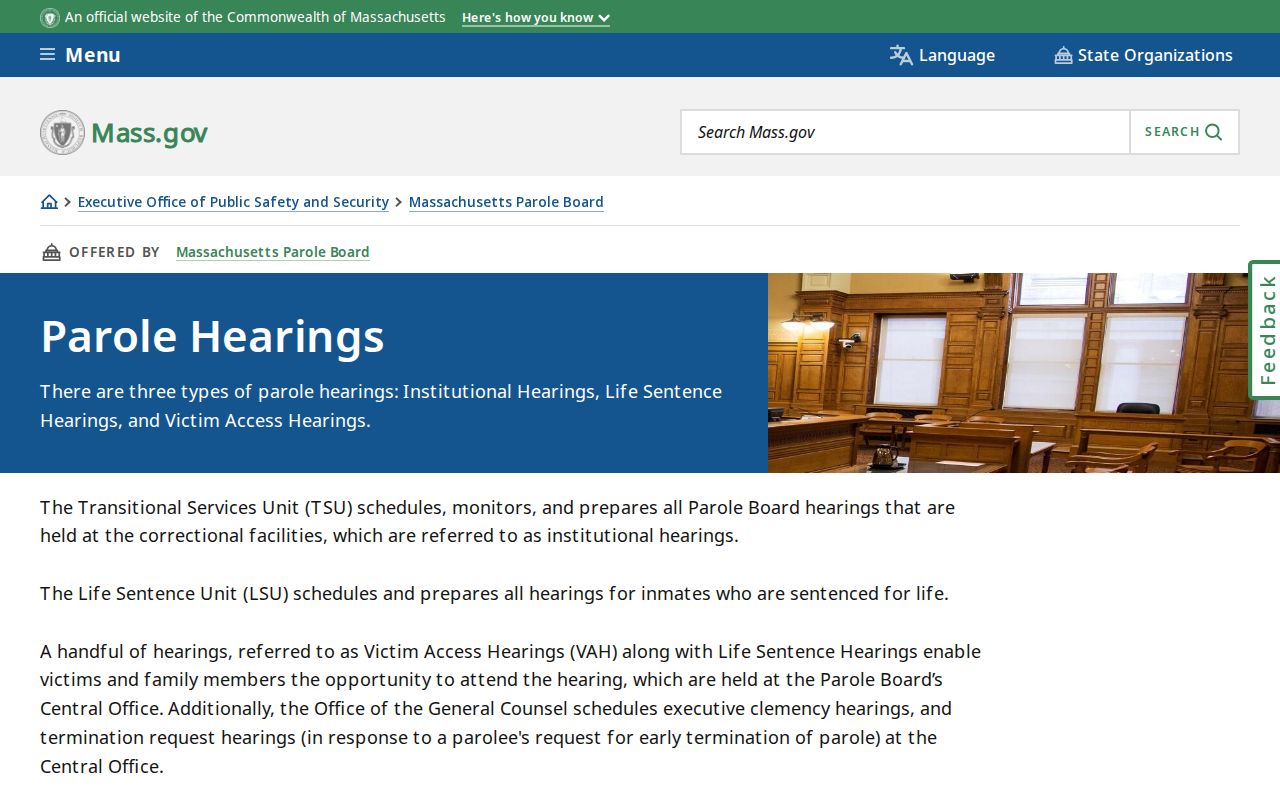
The separate routes shown there explain why a life-sentence calendar, a termination file, and an ordinary institutional hearing should not be read as the same record set. Decision terms also require care. A grant can depend on an approved release plan and conditions. A denial can set a review period. Rescission occurs before release, while revocation concerns a person already on parole. Termination granted or denied addresses the end of supervision. A split vote without enough votes results in denial, and “deferred” should be used only when the actual decision uses that term.
Suffolk County Supervision Warrants
Massachusetts publishes a reporting route, not a complete parole-absconder database. The Parole Board Warrant and Apprehension Unit is located at 60 Clayton Street in Dorchester and can be reached at 617-376-6269. A selective Most Wanted list cannot prove that a person is in good standing simply because a name does not appear.
No official statewide probation-absconder list was found in the researched sources. Under M.G.L. c. 279, §3, a probation officer may act on probable cause of a violation. That does not permit an inference from a missed meeting or a sparse public docket. A warrant, detainer, or violation order should be verified from the agency or court record that created it.
Victims have separate access routes. The Probation Service Victim Services Unit may help an eligible victim identify the supervising officer and obtain limited safety-related information. The DCJIS Victim Notification Registry is also access-controlled. Neither route is an open public parole or probation lookup.
Note: VINELink reports DOC custody changes where available; it does not verify a Suffolk County parole or probation violation.
Suffolk County Reentry Before Discharge
The Richard Pacitti Reentry and Transitional Center adds a distinctly local stage before some Suffolk County releases. Its reentry program description identifies discharge panels for people about 90 days from release, help with identity and vital documents, transportation coordination, and follow-up with returning people and families for one year. Transportation may be coordinated to a home, parole office, or residential treatment program.
Those services do not establish a legal discharge date. They support a planned move from custody. A parole grant may still depend on an approved plan, and an SCSD release can lead to another form of supervision. The actual release record remains the source for the completed custody event.
Community Corrections must be read with the same care. SCSD’s Custody Assessment division describes people placed at home or in halfway settings while still under departmental custody. Movement into that setting is not the same as final release from the underlying sentence.
Suffolk County Supervision Discharge
Parole can end at sentence expiration or through a granted termination request. Probation ends according to the court order and any later judicial action. A release from prison is not the same event as discharge from parole, and the end of a jail term does not prove that a probation term has closed.
For parole, obtain the Board record that shows termination or sentence completion when access rules permit. For probation, check the sentencing docket and request the relevant public order from the clerk. If physical custody dates are also at issue, match those records to the SCSD or DOC release document. Each source answers its own part of the timeline.
A parole reserve date deserves separate treatment. The Parole Supervision Manual calls it the earliest possible date, and release may still depend on an approved plan or a lower-security placement. The executed permit and the custodian’s release entry establish that the grant was carried out. Without those later records, a favorable vote establishes a decision, not the day the person left custody.
Massachusetts public-record law does not override all supervision restrictions. M.G.L. c. 276, §100 protects centralized probation and release-information records from general inspection. Parole client files also require authorization in ordinary cases. Public life-sentence decisions and court docket entries remain useful, but they should not be stretched beyond what they state.