
Suffolk County Release Records Explained
A release is a custody event, not one fixed outcome. Suffolk County Sheriff’s Department records can show a person leaving Nashua Street Jail, South Bay House of Correction, or a conditional placement. Massachusetts Department of Correction records cover state facilities such as Boston Pre-Release Center. Boston Police holds its own short-term booking records. The last custodian matters because each office can only certify its part of the trail.
The Commonwealth’s official admissions and releases definitions include community release, parole, probation, bail, time served, court release, transfer, and events that leave a person incarcerated. A person can leave Nashua Street for South Bay, DOC, another county, a federal authority, or immigration custody. That person is released from one status but not necessarily free in the community. A bare “release” label must be read with its event type and destination.
Custody can also end while another legal duty remains. Bail and personal recognizance require a return to court. Parole follows prison or house-of-correction release under Parole Board supervision. Probation is imposed and supervised through the Trial Court. Discharge usually means the relevant sentence ended, while transfer means a new agency received the person. These terms describe very different Suffolk County release paths.
A person who leaves a live custody check may have been released, transferred, renamed under another identifier, or removed by access restrictions. Absence alone proves none of those outcomes.
Suffolk County Inmate Release Types
The official event category is the best starting point for reading a Suffolk County release record. It connects the physical exit to the next legal status. The table uses Massachusetts terms and avoids treating every jail departure as a community return.
| Release type | Meaning | Next confirmation |
|---|---|---|
| Bail or recognizance | Pretrial custody ends under court terms; the case continues. | SCSD release entry and the criminal docket |
| Time served or court release | Held time satisfies the sentence, or a judicial order ends the custody basis. | Actual exit time plus the court event |
| Parole | Physical custody ends while Parole Board supervision begins. | Release document and authorized parole record |
| Probation | Custody ends and court-ordered supervision follows. | Docket and the sentencing probation office |
| Expiration or discharge | The relevant sentence ends, with no assumed supervision unless the record states it. | Certificate or final release entry |
| Transfer or remain incarcerated | One agency or legal status ends while another holds the person. | Receiving agency and destination field |
The Massachusetts release taxonomy also includes death, escape, missing or other legacy events, home confinement, and release to another criminal-justice agency. Those categories need careful wording. Home confinement can remain a custody status, and an escape is not lawful release.
The official source shows how transfer and release categories differ.
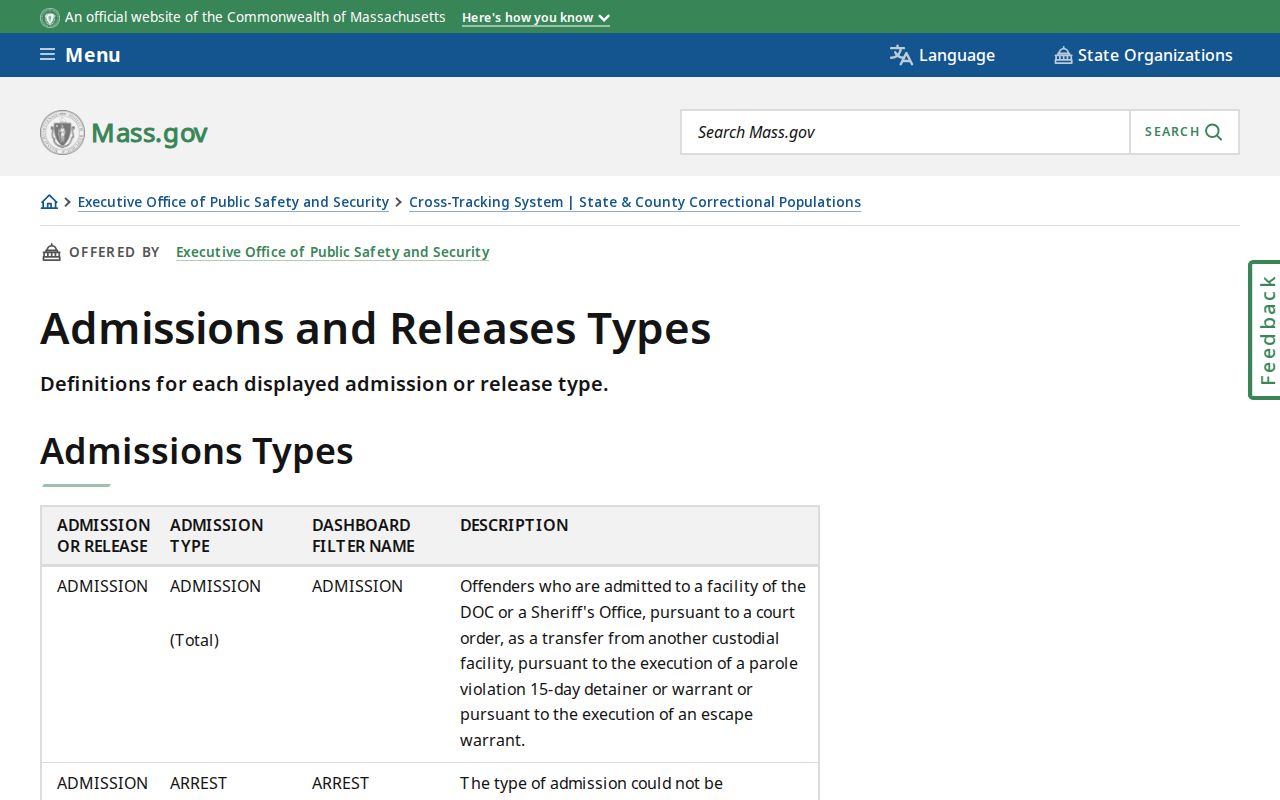
That distinction is why the destination field can be as important as the release date.
Suffolk County Release Record Fields
A useful request ties a person and booking to the completed event. SCSD does not promise a public web profile with a standard field set, so the items below are fields to request from an existing booking, inmate-system, or release document. The agency may redact material under privacy, CORI, investigatory, medical, juvenile, or other lawful limits.
| Field | What it establishes |
|---|---|
| Committed name and SCSD ID | Links the event to the correct Suffolk County booking. |
| Booking or admission date | Separates the custody episode from an earlier or later case. |
| Releasing facility | Identifies Nashua Street, South Bay, a DOC unit, or another custodian. |
| Actual release date and time | Shows when physical processing was completed. |
| Release event or reason | Distinguishes bail, time served, parole, expiration, transfer, and other outcomes. |
| Destination or receiving agency | Shows community return, supervision, or continued custody when releasable. |
| Docket or commitment reference | Connects the custody entry to its judicial authority. |
| Record update time | Helps reconcile entries created at different stages of processing. |
Three dates must remain separate. A court-order date records what a judge directed. An Earliest Release Date or ERD is a sentence calculation that can include parole eligibility and deductions. An actual release date and time records the finished custody event. A warrant check, detainer, new sentence, or transport step can create a gap between the first two dates and the last.
What does “disposed” mean on a docket? It means the case reached a disposition. It does not prove the jail finished release processing or that no other docket, warrant, or agency kept custody.
Suffolk County Release Booking Trends
SCSD’s dated statistical report counted release bookings, not unique people. That denominator matters because one person may create more than one custody episode. The historical figures help describe the scale and mix of Suffolk County releases, but they do not predict a named person’s outcome.
The report also included ten deaths within the release-event total. That fact reinforces the core point: an administrative release count cannot be read as a count of people who returned to the community. Each Suffolk County release record needs its own type and destination.
Request Suffolk County Release Records
SCSD has no researched public name-based release archive. A formal request should ask for existing records, not a new written explanation. The SCSD Records Access Officer receives focused requests for Sheriff’s Department material. Use the booking or date range to limit the search and ask for electronic copies.
- Identify the full name, known date of birth, SCSD or booking number, facility, and narrow custody period.
- Request the booking sheet, admission and transfer entries, final release or discharge entry, actual date and time, event type, destination, and docket reference.
- Describe a booking photograph as a separate item tied to the same booking event.
- Ask for all reasonably segregable nonexempt material and the legal basis for any redaction or withholding.
- Keep the written response, then compare its date and destination with the originating court order or receiving agency.
Office of General Counsel
200 Nashua Street
Boston, MA 02114
617-635-1100 x6373
psullivan@scsdma.org
Under M.G.L. c. 66, §10, an agency generally produces records or sends a compliant written response within ten business days. The state-agency fee framework usually gives the first four labor hours without charge, then permits the lowest-paid capable employee’s time up to $25 per hour unless another rate is approved. Actual copy or storage costs may apply. SCSD does not publish a separate agency fee table or RAO office hours.
Massachusetts retention rules keep many underlying items well beyond a public display. The statewide schedule lists House of Correction records for 25 years after release, detainee records for three years after final release, mittimus files for ten years after release or parole termination, and correctional photographs for ten years or until superseded. Retention does not guarantee disclosure, but no web roster does not mean the record vanished.
Note: Verify the named RAO on the SCSD contact page before submitting because agency personnel and assignments can change.
Suffolk County Records After Sealing
Massachusetts treats court access, agency public records, sealing, and expungement as separate systems. A criminal docket comes from the clerk under court-access rules, not through an ordinary Chapter 66 request. A sealed case leaves ordinary public view. Its absence from a name search therefore cannot prove that no case existed or that custody continued.
Eligible conviction sealing under M.G.L. c. 276, §100A uses waiting periods measured through all parts of the disposition, including custody. The research identifies at least three years for an eligible misdemeanor and seven for an eligible felony, subject to statutory conditions. Expungement is destruction rather than restricted public access. M.G.L. c. 276, §100E defines the covered record broadly enough to include incarceration and release.
Neither rule supports guessing. A restricted court result may explain why one channel is quiet, while SCSD or DOC must still apply the law to its own responsive files. Ask the clerk or records officer about the correct access route instead of treating a blank web search as a custody fact.
Suffolk County Property After Release
Nashua Street Jail publishes a local post-release property process even though it publishes no release list or processing schedule. Property pickup is available Monday through Friday from 9 to 11:30 a.m. and 7 to 10 p.m., excluding weekends and holidays. The collector needs photo identification. If the person left without completing the facility form, a collector may need a signed, notarized authorization.
The Jail holds property for 30 days after release. Canteen funds follow a different path and are returned by check. These rules help someone retrieve belongings after a confirmed Suffolk County release, but a property pickup arrangement does not itself establish the legal release type or destination. Jail Records remains the source for that event.
Suffolk County Bail Release Checks
Nashua Street’s official page says a bail commissioner is available after 5 p.m. on weekdays and on call during weekends. This supports after-hours bail processing. It does not promise an exact door-out time. A warrant-system check, payment conditions, paperwork, transport, or another hold can affect the completed release.
A bail release ends the current custody episode but not the criminal case. Pair the SCSD actual release entry with the correct MassCourts docket. The docket can show the bail or recognizance order and later court dates, while the jail record supplies the physical exit time.
Find Suffolk County Released Inmates
The search path begins with the last known facility. Suffolk County has three SCSD operations, two DOC facilities, Boston Police lockups, and cases that can move to federal or immigration custody. A name checked in the wrong system may return nothing even while the person remains held elsewhere.
- Identify Nashua Street, South Bay, Community Corrections, a DOC unit, a police lockup, or a federal custodian as precisely as possible.
- Call Jail Records at 617-635-1100 x3005 or HOC Records at 617-635-1000 x2017. Ask whether SCSD still has custody and, if not, the actual date, event, and destination.
- Search the correct Trial Court division. Review events, disposition, sentence, and release or bail orders, then request the clerk’s official document if needed.
- Follow any transfer. DOC custody routes to Massachusetts VINE while housed and DOC records after release. Parole, probation, BOP, and ICE each have separate confirmation paths.
- File a focused SCSD, DOC, or BPD request when the phone answer or online record does not supply documentary proof.
Suffolk County publishes no official online roster or 24-hour or 72-hour release feed. The records line, court docket, and focused records request are the official fallback chain.
The Suffolk County 24-hour release process applies the phone-first method to same-day questions. It should not be confused with a feed that SCSD does not publish. For one named person, trace the whole custody chain instead.
Suffolk County DOC Release Lookup
Massachusetts sends public prison-location checks to VINELink. The official Massachusetts prison locator instructions require a full first and last name or commitment number and state that only Massachusetts DOC participates. That coverage includes Boston Pre-Release Center and DOC custody at Lemuel Shattuck, but it does not create a complete Suffolk County Jail or House of Correction search.
| Search field | Use | Limit |
|---|---|---|
| Full first and last name | Find a possible current DOC record. | Similar names need facility or identifier comparison. |
| DOC commitment number | Targets the state correctional identity. | It is not an SCSD booking number. |
| Facility or custody detail | Confirms a matching live DOC placement. | Departure may be transfer, not discharge. |
| Notification control | Registers for offered custody-change alerts. | An alert still needs status confirmation. |
The Massachusetts form shows the state-specific person search.
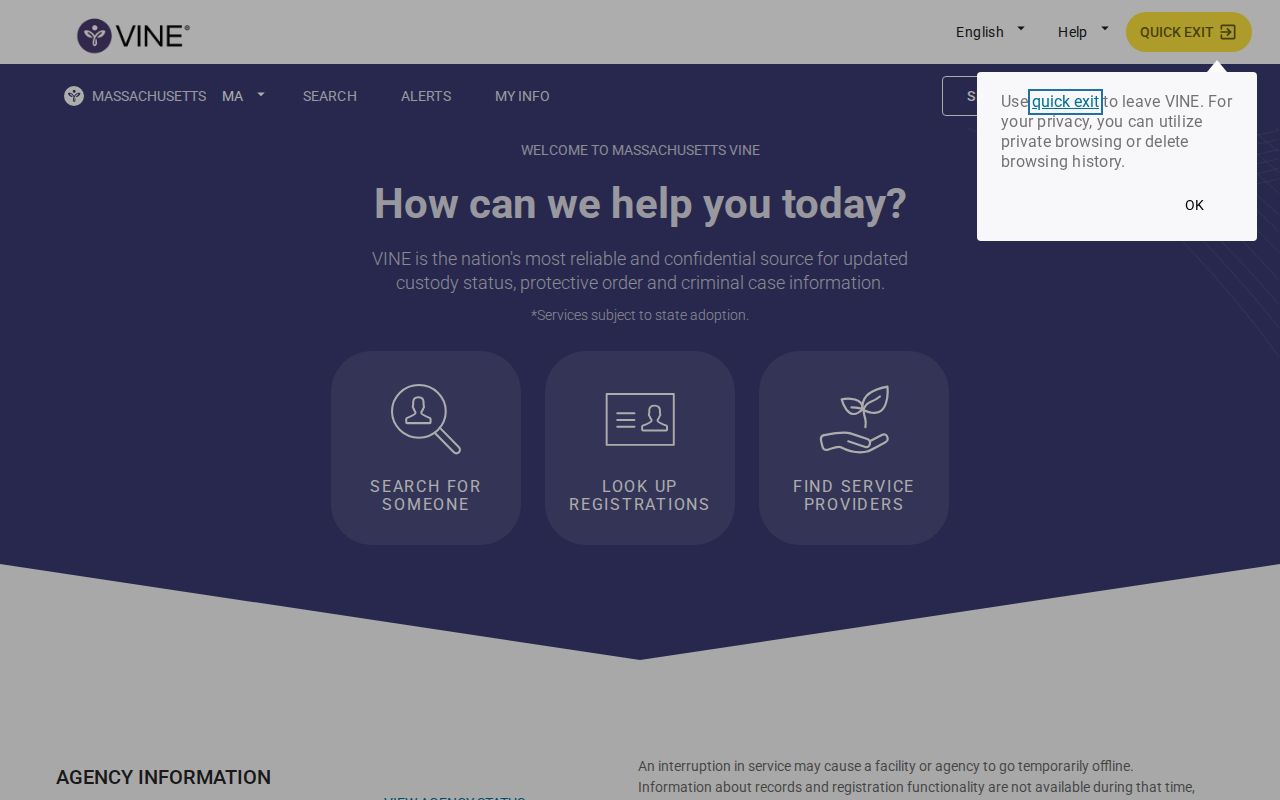
A match can support current DOC custody. No result is inconclusive and does not supply a durable discharge certificate.
For an already released state prisoner, request the Certificate of Discharge or Release, approved release order, actual date, type, destination, and sentence-computation fields from the DOC Records Access Officer. ERD and ERD Max are calculation terms, not promises that a public VINE result will show a stable projected date.
Suffolk County Release Court Search
Suffolk’s court geography makes a one-location name search unreliable. Boston and Winthrop matters can sit in any of eight Boston Municipal Court divisions. Chelsea District Court serves Chelsea and Revere. Suffolk Superior Court handles felony jurisdiction beyond the lower courts’ final authority. The correct court division and docket number are often essential.
The official MassCourts instructions explain party, event, docket, and disposition details. Most criminal cases are remotely searchable only by docket number. A search that stops at Central BMC can miss a Dorchester, East Boston, Chelsea, or Superior Court case that explains the Suffolk County release.
The court record establishes the judicial basis, not usually the exact time SCSD finished processing. Use it with the jail or DOC release entry. If online access is limited, contact the clerk for the public file.
Suffolk County Release Reentry Planning
The Richard Pacitti Reentry and Transitional Center describes monthly discharge panels for people about 90 days from release. Its local work can include transportation coordination to home, a parole office, or a residential treatment program, help with identity and vital documents, basic necessities, and follow-up with returning people and families for one year.
Those services are planning support, not proof that a sentence ended. SCSD Community Corrections can place selected people at home or in a halfway house while departmental custody continues. A person may be outside the secure HOC building yet still be in conditional pre-release status. Confirm the later final discharge with Custody Assessment, Records, and the docket.
Getting Home After Suffolk Release
Local transportation details depend on the facility. The Pacitti Center may coordinate travel to home, a parole office, or a residential treatment program for people it serves. That help is not promised in every Suffolk County release and should be confirmed before someone relies on it.
Nashua Street is across from the Museum of Science Green Line stop and has no jail parking. South Bay publishes Route 10 bus directions. These are practical ways to plan travel after a confirmed release, not a guarantee of a sheriff ride or a designated pickup point.
Suffolk County Post-Release Supervision
Parole and probation are distinct. The Massachusetts Parole Board decides and supervises parole after HOC or DOC custody. The Massachusetts Probation Service is part of the Trial Court and manages court-ordered probation. Massachusetts has no researched open name-based parole or probation lookup for general public use.
A docket can show that probation was imposed, but it cannot establish current compliance or an early termination. Parole grant decisions and reserve dates are also not physical exit timestamps. The Suffolk County probation and parole process explains the authorized record routes, regional office, hearing records, and limits. Pair any supervision record with the completed SCSD or DOC release document.
Suffolk County Federal Release Records
No federal prison is physically in Suffolk County, but a federal case can place a local defendant anywhere in the national system. The BOP Inmate Locator searches by federal register, DCDC, FBI, or INS number, or by name with demographic details. Its result can show a release date and a status such as Released or Not in BOP custody.
BOP warns that release information can change and that a person may be held by another authority or remain under supervision. A federal pretrial defendant may also be in U.S. Marshals custody at a local contract bed without yet appearing as a sentenced BOP prisoner. The federal docket and holding agency fill that gap.
ICE’s detainee locator uses an A-number and country of birth or biographical fields. It is a current detention route, not a Suffolk County release archive. SCSD ended its ICE detention contract in 2019. A documented handoff to ICE is a transfer into federal custody, not community release, while a negative ICE result can reflect release, removal, transfer, delay, or a search mismatch.
Verify Conflicting Suffolk Release Dates
A December 2025 state audit found that SCSD lacked documented mittimus-retention procedures even though mittimus data supports the inmate system and admission, transfer, and release work. A mittimus is the court’s formal commitment document. SCSD reported plans to standardize its process.
This local finding gives a practical rule for Suffolk County release records. When a sheriff date, court order, or destination conflicts, obtain both the SCSD release entry and the originating court document. Ask the records officer and clerk to identify which date marks the order, which marks processing, and whether another hold or transfer followed.
Suffolk County Release Facilities
Each Suffolk County facility has its own release trail. Nashua Street handles mainly pretrial detention; South Bay houses sentenced and some pretrial people; Community Corrections manages conditional placements. Boston Pre-Release Center and Lemuel Shattuck are DOC facilities, while Boston Police lockups precede bail, court, or transfer.
- Suffolk County Jail: call Jail Records and match the exit or transfer with the originating docket.
- Suffolk County House of Correction: confirm expiration, parole, probation, court release, community placement, or transfer.
- Suffolk County Community Corrections Center: distinguish conditional placement from final discharge.
- Boston Pre-Release Center: use DOC custody, sentence, discharge, and parole records.
- Lemuel Shattuck Hospital Correctional Unit: identify the parent custodian and destination after medical movement.
- Boston Police Department District-Station Lockups: trace station release, court presentation, or transfer through BPD and the court.
Starting with the last custodian avoids the most common error: treating a move out of one building as the end of every form of custody.