
Suffolk County Projected Release Dates
A projected date is a calculation based on sentence terms and information available at a given time. The actual release date is the completed custody event. Massachusetts records use several dates because parole eligibility, maximum sentence expiration, physical exit, and final discharge describe different points. One label cannot safely stand in for all of them.
For a sentenced state prisoner, DOC’s Central Date Computation Unit applies the commitment documents, jail credit, sentence structure, and authorized deductions. For a sentenced person at the Suffolk County House of Correction, HOC Records maintains sentence, jail-credit, earned-time, bail, and warrant data. A person held pretrial at Nashua Street lacks a sentence-based projected date. A bail order or dismissal may create an expected release, but processing and other legal holds still control the physical exit.
Physical exit and sentence completion can also diverge. A person may leave prison on parole yet remain under the sentence. Massachusetts cross-tracking data calls one field “Date Exiting Custody” and another “Actual Release from Sentence Date.” The second can occur later because it includes parole or a post-sentence judicial action.
Note: A court release order can precede jail processing, so the order date and Suffolk County actual release time may differ.
Find Suffolk County Projected Release
The correct route starts with the last confirmed custodian. Massachusetts VINELink is documented as a locator for people housed in DOC, not a public sentence-computation database. Its official page does not guarantee that each result shows a stable projected date. Detailed ERD and ERD Max figures should come from DOC sentence records. County-sentence information comes from SCSD, while the docket supplies the judicial terms that underlie the calculation.
- Determine whether the person is pretrial, serving an HOC sentence, or serving a Massachusetts DOC sentence. Do not use the county of the case as proof of custody.
- For DOC custody, search by full name or commitment number to confirm the current facility. Then request the sentence computation sheet and date history from DOC.
- For the Suffolk HOC, call Records at 617-635-1000 x2017. Ask for the current sentence calculation, jail credit, earned time, and any warrant or hold affecting release.
- For Nashua Street, call Jail Records at 617-635-1100 x3005 and check the criminal docket. A pretrial case needs the release order and completed custody event, not a projected sentence date.
- Match the agency calculation to the mittimus and docket. A mittimus is the court commitment document that authorizes custody and states the sentence terms.
A broader search for the completed custody event and release record appears on the Suffolk County released-inmate home page. That route is useful when the question has shifted from “when” to “did release occur.”
The SCSD Custody Assessment source describes the sentence, earned-time, bail, and warrant functions maintained for HOC custody.

Those functions show why a Suffolk County HOC date must come from Records rather than a generic online estimate.
Suffolk County Release Date Fields
The Massachusetts DOC Glossary provides the terms needed to read a sentence record. The maximum date is sentence expiration. The minimum sentence date ordinarily controls state-prison parole eligibility. A parole eligibility date is the first date the Board may consider release, not a promise that release will follow.
| Massachusetts field | What it means |
|---|---|
| Maximum Date | The sentence-expiration date before the applicable computation details are read. |
| Minimum Sentence Date | The state-prison minimum that ordinarily controls parole eligibility. |
| Parole Eligibility Date | The earliest date for Board consideration, not guaranteed release. |
| ERD | Earliest release eligibility including parole eligibility and deductions potentially earned. |
| ERD Max | Controlling-maximum calculation with specified earned and program deductions, excluding parole eligibility. |
| Release to Supervision Date | A date calculated under the statutory supervised-release framework. |
| Date Exiting Custody | The physical exit from the custody episode in cross-tracking data. |
| Actual Release from Sentence | Completion of the sentence, which can occur after physical prison exit. |
Some EOPSS data uses “Release Date” for an initial calculation based on sentence terms before future deductions. It is not necessarily the exit day. The record-level ERD and ERD Max are best obtained through a focused DOC request rather than assumed to be visible in VINELink.
A useful DOC request names each field instead of asking the agency to predict release. Request the sentence computation sheet, maximum and minimum dates, ERD and ERD Max, jail-credit entries, later adjustments, the actual release date if it has occurred, and the institution responsible for release. That scope lets the requester compare the calculation with the court sentence without treating a live locator screen as the official computation. The official glossary display can be checked at the linked DOC source.
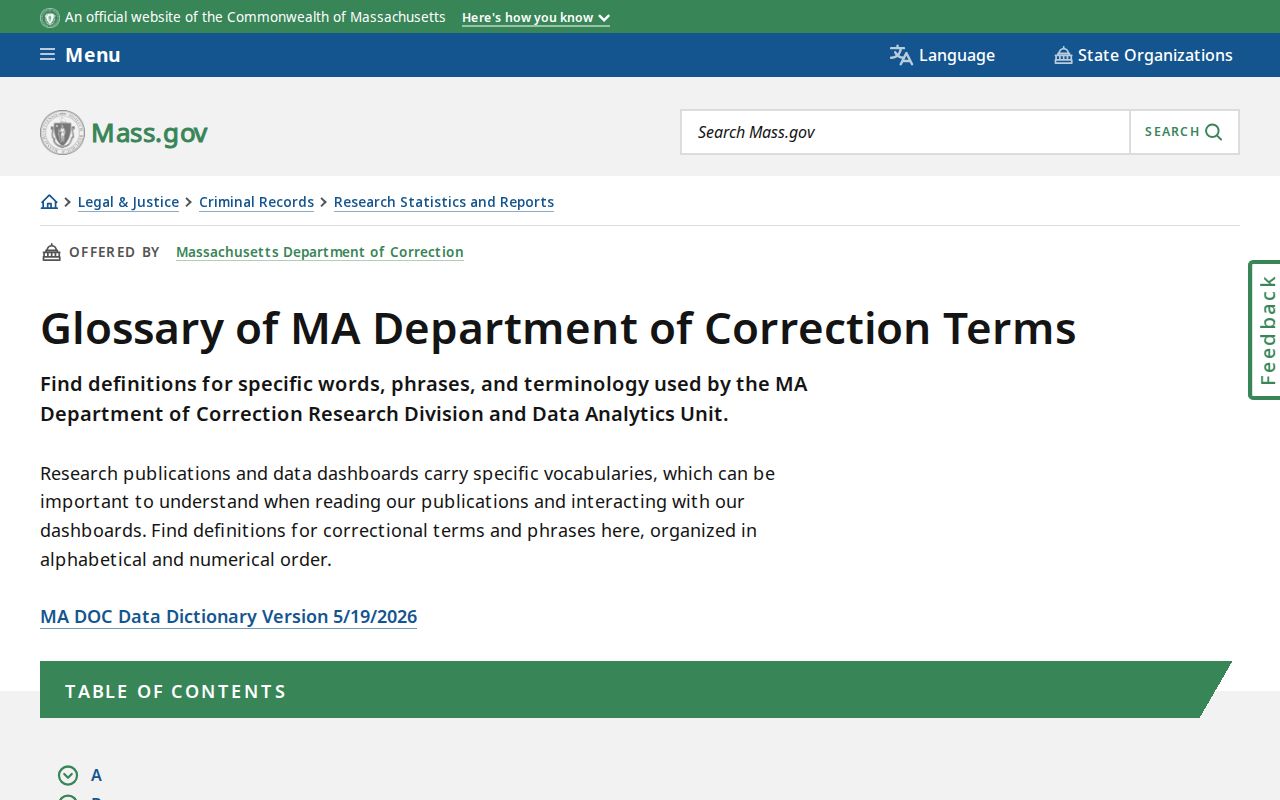
The distinct ERD, ERD Max, expiration, and actual-release terms reinforce that Massachusetts has no single public date label for every release question.
Suffolk County Earned Release Time
M.G.L. c. 127, §129D calls program participation and completion credits “good conduct deductions.” For state-prison participation, the statute permits up to 7.5 days per qualifying program or activity each month, capped at 15 days monthly. HOC participation can earn up to five days per program or activity monthly, capped at ten days per month.
A further completion deduction can reach ten days. For an HOC sentence, that award requires an eligible program or activity with six months of satisfactory participation. State prisoners can receive designated completion credit up to 80 days, while aggregate completion credits are capped at 17.5 percent of the imposed maximum. Deductions cannot reduce the imposed maximum, or the minimum for parole eligibility, by more than 35 percent. The statute also requires a discharge certificate on the date fixed by deductions.
These are ceilings and rules, not a calculator for a named person. The agency record must show which programs qualified, what credit was awarded, whether any credit was lost or restored, and how the controlling sentence was structured. A docket sentence alone lacks that full history.
- Jail credit
- Credit for eligible time already spent in custody before or during the sentence.
- Earned time
- An authorized deduction tied to qualifying participation or completion.
- Concurrent sentence
- A sentence that runs at the same time as another sentence.
- Consecutive sentence
- A sentence that begins after another sentence or term.
Suffolk County Truth-in-Sentencing Limits
Massachusetts repealed its former statutory good-time system through the 1993 Truth-in-Sentencing changes. DOC states that old statutory good time does not reduce offenses committed after June 30, 1994. That history does not create a universal current rule that every person leaves after serving exactly 85 percent of a sentence.
Historical DOC material discussed expected service of 85 percent or more and compared it with a federal benchmark. Current §129D instead sets specific earned deductions, completion credits, caps, and exclusions. The practical answer to “Does Massachusetts require 85 percent?” is no single percentage can calculate every current Suffolk County projected release date. Obtain the official computation.
Parole adds another distinction. A state-prison sentence generally has a judicial minimum and maximum. Ordinary parole eligibility follows the minimum less applicable deductions, while the maximum controls final discharge. Eligibility permits Board consideration. It does not compel a grant, prove an approved release plan, or fix the day DOC will carry out release.
Suffolk County HOC Release Timing
House of Correction sentences use a different framework. Massachusetts law allows an HOC term up to two and one-half years. Under 120 CMR 200.02, an aggregate HOC term of at least 60 days generally becomes parole-eligible at half the aggregate term or two years, whichever is shorter, subject to mandatory-minimum restrictions.
Again, eligibility is not release. The Parole Board must act, an approved plan may be required, and SCSD must complete the custody event. A person may also leave the HOC through sentence expiration, a court order, probation, community corrections, or transfer to another authority. Each path can produce a different record.
Conditional pre-release is especially easy to misread. A Suffolk County Community Corrections participant may live at home or in a halfway placement while still subject to SCSD custody and return. That transition should not be labeled final discharge from the sentence.
Note: HOC parole eligibility, conditional placement, physical release, and sentence discharge are separate Suffolk County record events.
Suffolk County Release Date Changes
Official calculations change when the legal or factual inputs change. DOC’s Central Date Computation Unit reviews release orders, sentence entries, and the relevant chronology before approval. SCSD HOC Records performs the county-sentence functions documented by its Custody Assessment division. A private calculation cannot account for every correction or later event.
| Factor | Possible effect | Best confirming record |
|---|---|---|
| Corrected mittimus or jail credit | Moves the sentence start or controlling calculation | Court commitment and agency computation |
| Concurrent, consecutive, or from-and-after terms | Changes which sentence controls and when another begins | Docket, mittimus, and computation sheet |
| Earned-credit award or restoration | May move an eligible date earlier within statutory caps | DOC or HOC credit history |
| Credit forfeiture or discipline | May move a date later when authorized | Agency sentence record |
| Warrant or detainer | Can redirect custody even when one term ends | Issuing agency record and release destination |
| Parole action | Can permit release, deny it, rescind a grant, or set review | Board decision and executed release permit |
| New court order or sentence | Can alter the authority or duration of custody | Updated docket and computation |
To confirm a pending custody change, the Suffolk County VINELink search may provide a DOC alert where a live participating record offers registration. The alert still needs follow-up with DOC, the Board, or the court.
Suffolk County Weekend Release Rules
Massachusetts has two distinct weekend rules. Under M.G.L. c. 127, §150, when a term expires on a Saturday, Sunday, or legal holiday, discharge occurs on the preceding day. That rule applies to the end of a term and can move the statutory discharge earlier on the calendar.
A special weekend sentence under M.G.L. c. 279, §6A serves a different purpose. It ordinarily requires reporting Friday by 6 p.m. and release Monday at 7 a.m., or Tuesday when Monday is a holiday, unless the court orders otherwise. It is not a general release schedule for everyone held at Suffolk County Jail or the HOC.
The distinction prevents two errors. A normal sentence that expires on a weekend follows the preceding-day discharge rule. A sentence specifically authorized for weekend service follows its own report-and-release pattern. Neither statute promises how long administrative processing will take in an individual case.
If the date falls near a holiday, ask the responsible records office which statute and calculation control. Confirm any court-specific weekend order on the docket. The resulting agency entry, not a general calendar assumption, supplies the actual Suffolk County release time.