
Boston Pre-Release Center Outcomes
Boston Pre-Release Center is physically in Suffolk County but belongs to Massachusetts DOC. That ownership controls the release trail. A person can leave BPRC for another DOC institution, return from minimum status to a different custody level, enter parole, or discharge from the sentence. Work and community access are parts of pre-release classification. They do not establish that DOC custody ended.
Ask for both the physical exit and the legal outcome. A transfer entry should name another DOC site. A parole release should connect to a Parole Board permit or supervision record. Final discharge should be supported by a DOC Certificate of Discharge or Release, approved Release Order, and sentence computation. The sentencing docket adds the term and later court action. No SCSD record is needed unless there was a separate county custody episode.
| BPRC event | Status after exit | Confirmation |
|---|---|---|
| DOC transfer | Still in state custody | VINELink while housed and DOC movement record |
| Parole release | Community under parole supervision | DOC release order and Parole Board record |
| Sentence discharge | DOC sentence ends | Certificate of Discharge and computation |
| Work or community programming | Still DOC custody unless separately released | Current DOC status and institutional record |
Confirm BPRC Release Status
The Commonwealth’s “Find someone housed in a Massachusetts prison” instructions route public searches to VINELink. Search by full first and last name or DOC commitment number. The state page says only Massachusetts DOC participates in Massachusetts VINE, so BPRC is within the documented scope. A match supports current DOC custody and location, but the locator is not presented as a lasting archive of discharged people.
- Search Massachusetts VINELink with the full name or commitment number and compare identity and facility.
- If BPRC or another DOC site appears, treat the result as evidence of current DOC custody, not release.
- If no record appears, do not infer discharge; contact DOC and check the sentencing docket.
- Request the actual release date, type, destination, Certificate of Discharge or Release, and sentence computation.
- If parole followed, confirm the new status with the Massachusetts Parole Board.
The Suffolk County released-person search path helps separate this state route from SCSD, Boston Police, and federal custody. A no-result can reflect spelling, identifier mismatch, data limits, transfer, or release. Only the completed DOC record establishes the event.
BPRC Release Record Contact
Facility staff can route current institutional questions, while DOC’s Records Access Officer handles formal record requests. Ask for the commitment number, releasing institution, actual release date, release type and destination, approved Release Order, Certificate of Discharge or Release, and the nonexempt sentence-computation fields showing ERD and ERD Max. ERD means earliest release eligibility; ERD Max is a maximum-sentence calculation that excludes parole eligibility.
Boston Pre-Release Center
430 Canterbury Street
Roslindale, MA 02131
617-822-5000
Massachusetts DOC Public Records
50 Maple Street
Milford, MA 01757
508-422-3436
doc.rao@state.ma.us
DOC accepts online and email requests and warns that privacy rules may require redaction. It does not process county Jail or HOC records. Ask for electronic delivery and offer to narrow the scope before chargeable work. The published state-agency framework generally provides the first four labor hours without charge, with later labor subject to stated limits.
Note: BPRC’s telephone line is not a substitute for the signed DOC documents that establish a completed sentence or parole release.
Boston Pre-Release Center Records
BPRC houses criminally sentenced men in minimum and pre-release custody. It is a state prison, not a Suffolk sheriff facility. Its Roslindale address creates local relevance, but location does not transfer record ownership to Suffolk County. DOC controls institution, sentence, transfer, and discharge records.
The official Boston Pre-Release Center page provides its state identity, address, and phone, as shown in the captured source.
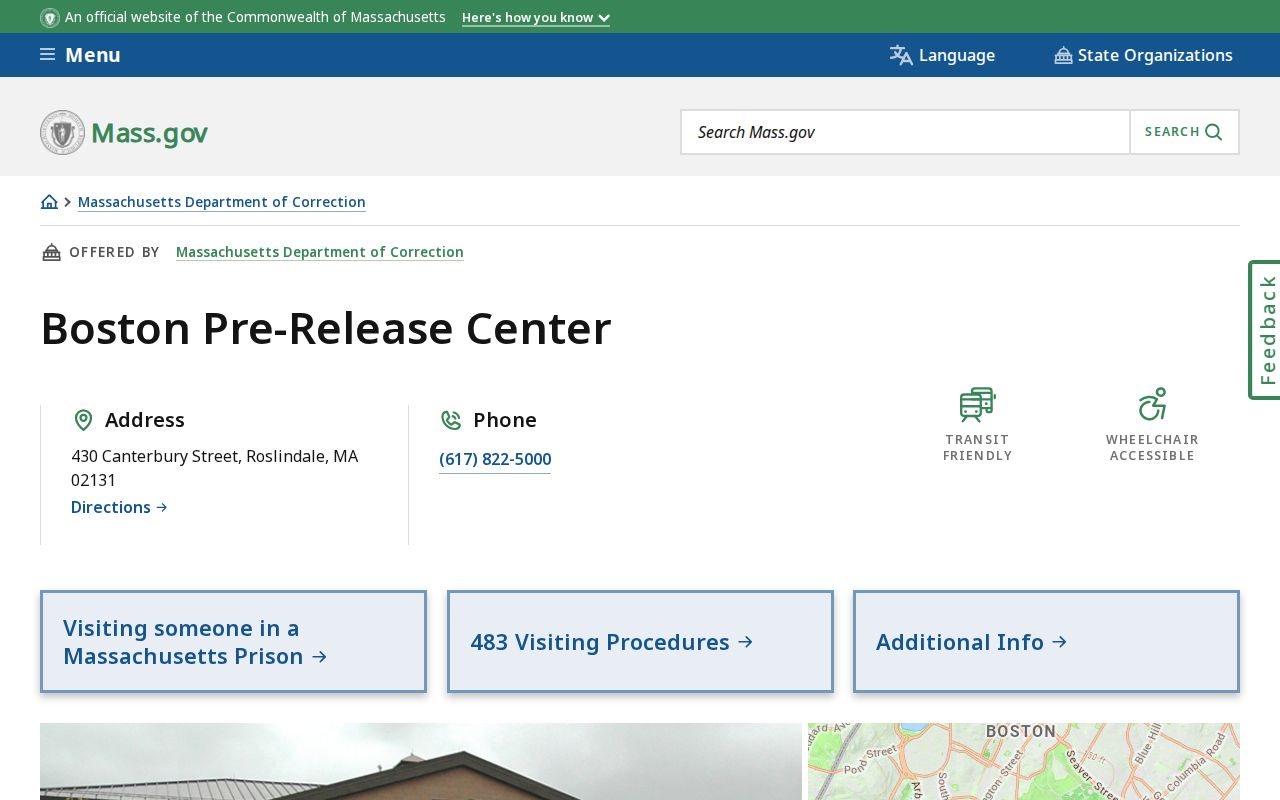
The state listing supports use of Massachusetts DOC and VINELink rather than the Suffolk County Jail Records lines.
Pre-release is a custody classification. It can support preparation for community return, but a person can still be transferred or returned within DOC. Avoid describing participation as discharge. The actual release order and DOC computation are the decisive records.
BPRC Release Date Records
Massachusetts uses several date terms. The maximum date concerns sentence expiration. A minimum sentence date ordinarily controls state-prison parole eligibility. ERD includes applicable parole eligibility and potential deductions, while actual release is the completed event. None should be presented as a guaranteed exit date without the official computation.
Detailed ERD and ERD Max fields are best obtained from DOC sentence records. Official public documentation does not promise that every VINELink profile displays a stable projected date. The Central Date Computation Unit reviews orders, time entries, and chronology before approval. Corrected mittimus data, jail credit, concurrent or consecutive terms, new sentences, earned-credit changes, disciplinary action, warrants, detainers, parole decisions, and court orders can alter the expected date.
For a completed BPRC release, ask for the actual event instead of recalculating from the docket. The docket sentence provides essential context but may not include all later administrative credits and holds.
BPRC Parole Release Records
Parole eligibility is not parole release. The Massachusetts Parole Board must act, and an approved plan or conditions can matter before the person leaves BPRC. A grant can also be rescinded before release. Therefore, a hearing result, reserve date, or eligibility date should not be reported as the actual day of exit.
When parole follows, preserve two layers. DOC records the physical release from BPRC and the release type. The Parole Board records the supervision phase. A person can be out of prison yet remain under parole until termination or sentence completion. The sentence docket adds the judicial foundation, but the board and DOC prove the transition.
BPRC Discharge Record Fallback
If VINELink returns nothing, use the DOC records request rather than a county recent-release search. Supply the full name, commitment number if known, BPRC, sentence court, and narrow date range. Ask for a direct set of existing records. A focused request is easier to process and less likely to capture unrelated protected material.
MassCourts may show the conviction, sentence, later order, and disposition, though remote criminal access can be limited. Contact the clerk when the online docket is incomplete. If official sources conflict, ask DOC to reconcile the computation and event date rather than selecting the more convenient result.
Note: The statewide DOC releases dashboard describes trends and categories, but it cannot prove a named BPRC person’s outcome.
BPRC Offender Release Record Set
A strong DOC request ties institution, sentence, computation, and completed outcome together. Identify Boston Pre-Release Center, the commitment number if known, the sentencing court, and a narrow period. Ask for institutional movement entries, the approved Release Order, Certificate of Discharge or Release, actual release date, type, destination, and nonexempt sentence-computation fields. If the record shows parole, add the Massachusetts Parole Board record rather than asking DOC to describe supervision it does not administer.
Massachusetts terminology deserves care. The Maximum Date is sentence expiration. The Minimum Sentence Date ordinarily controls parole eligibility. ERD can include parole eligibility and deductions, while ERD Max is based on the controlling maximum with specified deductions and excludes parole eligibility. Release to Supervision is another calculation under the statutory framework. Actual Release from Sentence can be later than physical prison exit when parole or post-sentence judicial action remains part of the sentence history.
The statewide retention schedule lists individual institutional case records for five years after release or termination of parole and mittimus files for ten years after release or termination of parole. Retention is not an automatic disclosure command. Privacy, security, CORI, medical, or other restrictions can require redaction. Ask DOC to provide all reasonably segregable nonexempt fields and identify the basis for material it withholds.
The DOC Releases Dashboard is an aggregate tool. It can explain categories and trends across institutions, but it is not a named-person lookup. Likewise, a BPRC pre-release classification describes custody level, not the final event. The record set should prove both the date the person left BPRC and whether that move was a DOC transfer, parole release, or full discharge.
When the docket and computation appear inconsistent, do not select one date without review. Court records may omit later credits or administrative events, while a locator can lag or disappear after custody. Ask DOC’s Central Date Computation Unit or Records Access Officer to address the specific record conflict. The final approved documents carry more weight than an estimate based only on the imposed sentence.