
LSHCU Departure and Release
Lemuel Shattuck Hospital Correctional Unit is a secure medium-security medical unit. It provides inpatient and outpatient care to people from state and county custody. Its Suffolk County address does not make each patient a Suffolk detainee. Massachusetts DOC, SCSD, or another sheriff may remain the parent custodian throughout treatment.
When treatment or the unit stay ends, the person may return to the originating prison or HOC, move to another medical or correctional site, or experience a genuine community release under an order, parole, or sentence discharge. The LSHCU departure record alone cannot distinguish these paths unless it identifies the legal event and destination. The parent agency’s custody record is the stronger source.
| LSHCU departure | Correctional meaning | Record owner |
|---|---|---|
| Return to DOC prison | State custody continues | Massachusetts DOC |
| Return to county facility | Sheriff custody continues | Originating sheriff |
| Move to another secure medical site | Custody continues unless separately ended | Parent custodian and DOC movement records |
| Parole or sentence discharge | Actual correctional release | DOC or sheriff plus supervising agency |
Confirm LSHCU Release Status
Start with custody, not medical status. Massachusetts VINELink covers DOC participants, according to the Commonwealth’s official locator page. It can help locate a person who remains in DOC custody, including at LSHCU or a later state site. It is not a complete route for county patients and is not represented as a permanent archive of discharged people.
- Identify the facility or agency that sent the person to LSHCU.
- For DOC custody, search VINELink with full name or commitment number and contact DOC if no match appears.
- For county custody, call that sheriff’s records unit and ask whether custody continues after the hospital stay.
- Request the actual departure date, destination, and any separate release or discharge event.
- Check the court docket and Parole Board only when the parent record points to those paths.
The Suffolk County release-record route explains the separate DOC, SCSD, court, and federal channels. If the parent was another Massachusetts county, that sheriff remains the proper county custodian. A negative Suffolk search cannot prove release because Suffolk may never have owned the booking.
LSHCU Custody Record Contact
The official source provides the LSHCU address but does not publish a unit phone in the research. Do not substitute the general hospital number or invent facility hours. For state custody, use Massachusetts DOC’s public-record route. For a county patient, send the request to the originating sheriff.
Lemuel Shattuck Hospital Correctional Unit
180 Morton Street
Jamaica Plain, MA 02130
Secure Massachusetts DOC medical unit
Massachusetts DOC Public Records
50 Maple Street
Milford, MA 01757
508-422-3436
doc.rao@state.ma.us
For a DOC patient, ask for the commitment number, parent institution, LSHCU movement dates, destination after departure, and any separate Certificate of Discharge or Release. For an SCSD patient, Jail Records or HOC Records can confirm whether Suffolk custody continued. A records request may be redacted where medical, privacy, security, CORI, or other protected material is involved. Ask only for the custody facts needed.
Note: A narrow request for movement and discharge fields avoids seeking unrelated clinical records that do not prove correctional status.
LSHCU Correctional Record Scope
LSHCU combines a hospital setting with secure correctional custody. That dual role produces a special records problem. Clinical care may start or end while the legal custodian remains unchanged. The useful public question is not the diagnosis or treatment. It is which authority retained custody, when the person left the unit, and where the person went.
The Massachusetts DOC location list places LSHCU and Boston Pre-Release Center within the state facility system, as shown in the capture.
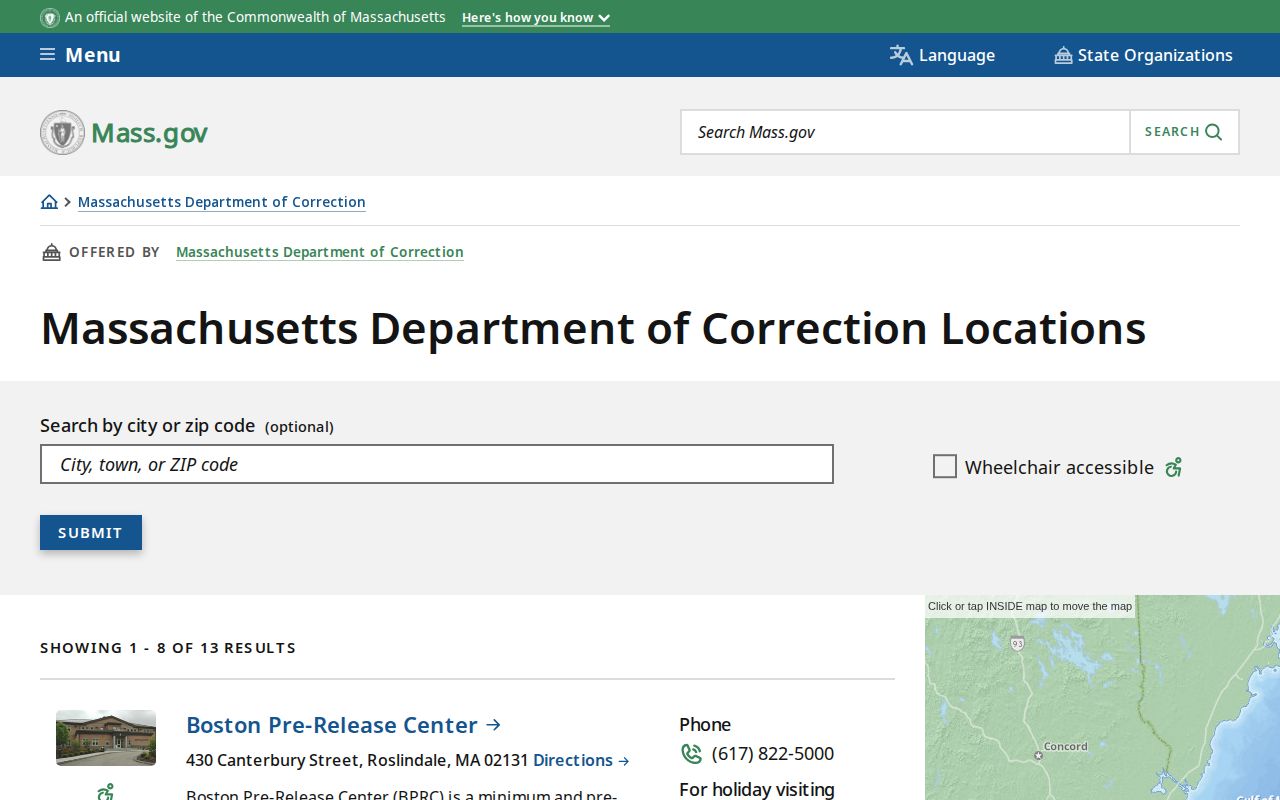
The listing confirms state operation and helps prevent LSHCU from being misclassified as a Suffolk County jail.
A current DOC locator result shows custody and location, not a future release promise. A county records response may show that a sheriff retained legal authority even while care occurred at LSHCU. Preserve the parent identifier and movement entries when following the trail.
DOC Patient Release Records
For a Massachusetts DOC patient, VINELink is useful while the person is housed. Search by full first and last name or commitment number. No result is inconclusive. The Commonwealth describes the service as a locator for people housed in state prison, not a guaranteed historical discharge profile.
After release, request the DOC Certificate of Discharge or Release, approved Release Order, actual release date, type, destination, sentence computation, and institutional movement history. ERD and ERD Max are calculation terms, not proof of the completed event. The docket and any Parole Board record complete the picture when court action or parole follows.
County Patient Release Records
If Nashua Street or South Bay sent the person to LSHCU, SCSD remains the key county source. Jail Records is 617-635-1100 extension 3005. HOC Records is 617-635-1000 extension 2017. Ask whether the person returned to the source facility, moved to another agency, or had a separate community release.
If a different sheriff sent the person, contact that county. Suffolk geography alone does not shift record ownership. The parent sheriff’s admission, transfer, and release entries should connect the medical movement to the later custody outcome. The court docket can then show the judicial basis for any completed release.
Note: The same LSHCU address can appear in records for people whose bookings and cases belong to different counties.
LSHCU Release Record Limits
Medical and privacy restrictions can narrow what an agency releases. That does not make clinical detail necessary to answer the custody question. Ask for dates, parent institution, movement type, destination, and final correctional event. Request reasonably segregable nonexempt portions and the legal basis for any withholding.
When sources conflict, compare the LSHCU movement entry, parent-agency custody record, court order, and any DOC or parole release record. A hospital document may accurately state that care ended while saying nothing about the sentence. The correctional document may accurately show continued custody after the same date. Both can be true.
LSHCU Custody Release Record Set
A focused LSHCU custody request starts with the parent institution and commitment or booking identifier. Ask for the date the person entered the correctional unit, the parent custodian, each institutional movement date, the destination after departure, and any separate actual release or discharge event. Avoid requesting diagnosis, treatment notes, or other clinical detail when the question is custody. Those materials are both sensitive and unnecessary to establish the correctional path.
For a DOC patient, the strongest record set includes the movement history, approved Release Order when one exists, Certificate of Discharge or Release, actual date, release type, destination, and sentence computation. For an SCSD patient, ask Jail or HOC Records for the admission, medical transfer, return or receiving-agency entry, and later final release. If another county sent the person, use that sheriff’s equivalent records route.
The court docket adds legal context. It can show bail, sentence, dismissal, probation, or another judicial order, but it may not record the exact time the custodial agency completed a hospital movement. A Parole Board record is relevant only when parole follows. Do not use parole eligibility or a proposed date as proof that LSHCU departure resulted in community release.
Massachusetts retention rules list individual institutional case records for five years after release or termination of parole, mittimus files for ten years, and House of Correction records for twenty-five years after release. A detainee series is retained for three years after final release. Which series applies depends on the parent custodian and legal status. The schedule does not guarantee disclosure, but it helps frame a request to the correct agency.
Build the timeline with paired entries. A DOC transfer out should connect to another DOC admission. A return to South Bay should connect to an SCSD movement entry. A claimed community discharge should connect to a release order, sentence discharge, parole permit, or other completed authority. When one side is missing, ask the parent custodian to identify the destination before classifying the event.
LSHCU’s Suffolk location can tempt a searcher to call only local agencies. Resist that shortcut. The person’s parent booking may belong to DOC or a sheriff far outside Suffolk County. The agency with legal custody immediately before and after the medical stay is the one most likely to hold the decisive release record. If the source agency is unclear, begin with DOC and the known sending facility rather than treating the hospital address as proof of ownership.